Strolling Through Time: Vienna’s Architectural Soul Uncovered
Have you ever walked down a street and felt like you stepped into a different era? That’s Vienna for you. With its stunning mix of Gothic spires, imperial Baroque palaces, and daring modern designs, the city feels like an open-air architecture museum. I wandered its streets with awe, discovering how each building tells a story of power, artistry, and cultural evolution—this is more than sightseeing, it’s time travel through stone and steel. From the medieval foundations beneath cobblestone alleys to the sleek glass towers rising near historic plazas, Vienna reveals a city that honors its past while quietly shaping its future. Every façade, dome, and doorway invites reflection, offering a narrative not just of architectural styles, but of a society that values continuity, craftsmanship, and beauty.
The Grand Stage: Vienna’s Historic City Center
At the heart of Vienna lies the Innere Stadt, the historic core enclosed by the sweeping arc of the Ringstraße. This district, recognized as a UNESCO World Heritage site, is a living chronicle of architectural evolution spanning over eight centuries. Walking through its narrow lanes and grand squares, one encounters layers of history etched into stone and mortar. The city's origins trace back to Roman times, but it was during the Middle Ages that its architectural identity began to take shape. St. Stephen’s Cathedral, with its striking multi-colored tile roof and soaring south tower, stands as a testament to Gothic mastery. Its construction began in the 12th century and continued for hundreds of years, absorbing stylistic shifts along the way. The cathedral’s intricate stonework, flying buttresses, and stained-glass windows reflect both spiritual devotion and technical ambition, serving as a focal point not only for religious life but also for civic pride.
Adjacent to the cathedral, the Hofburg Palace complex unfolds like a historical novel in masonry. Originally built as a fortress in the 13th century, it expanded over generations into a sprawling residence for the Habsburg dynasty. The blend of Gothic, Renaissance, and Baroque elements within its walls mirrors the changing tastes and political aspirations of Europe’s longest-ruling imperial family. Visitors today can wander through its courtyards, museums, and the Spanish Riding School, where the harmony between architecture and function becomes evident. The Imperial Palace was never just a home—it was a stage for diplomacy, coronations, and cultural patronage, designed to project stability and grandeur.
What makes the Innere Stadt exceptional is not merely the presence of individual landmarks, but the cohesion of its urban fabric. Despite wars, fires, and modernization, the district maintains a human scale and architectural continuity. Streets curve organically, leading to hidden courtyards and intimate plazas. The preservation of this historic center reflects a deep cultural commitment to memory and identity. Restoration efforts have been meticulous, ensuring that original materials and techniques are honored whenever possible. For the traveler, this means experiencing authenticity—not a reconstructed pastiche, but a genuine connection to centuries of urban life. The city center is not frozen in time; it breathes, hosting bustling markets, elegant boutiques, and timeless cafés where locals gather beneath chandeliers and gilded mirrors.
Imperial Elegance: The Baroque and Rococo Legacy
If the Gothic era expressed spiritual aspiration, the Baroque period embodied earthly power, and nowhere is this more evident than in Vienna’s imperial palaces. The 17th and 18th centuries marked the zenith of Habsburg influence, and architecture became a tool of political theater. Schönbrunn Palace, nestled in the western part of the city, exemplifies this grand vision. Originally a hunting lodge, it was transformed under Empress Maria Theresa into a summer residence of unparalleled opulence. The palace’s symmetrical façade, expansive gardens, and Hall of Mirrors rival those of Versailles, yet it carries a distinctly Austrian sensibility—slightly more restrained, yet infinitely detailed.
The Baroque style, characterized by dramatic curves, rich ornamentation, and theatrical lighting, was ideally suited to convey the divine right of kings. Interiors at Schönbrunn feature gilded stucco, frescoed ceilings, and parquet floors that shimmer under soft light. The Great Gallery, used for court balls and state receptions, stretches over 40 meters and is adorned with allegorical paintings celebrating the Habsburg lineage. Outside, the gardens unfold in geometric precision, with fountains, statues, and a grand fountain cascade leading the eye toward the Gloriette, a triumphal arch that crowns the hilltop. This seamless integration of architecture and landscape was intentional—nature itself was made to serve the narrative of imperial dominance.
Equally significant is the Belvedere Palace, a masterpiece of Baroque urban design located just south of the city center. Comprising the Upper and Lower Belvedere, the complex was built for Prince Eugene of Savoy, a military commander and art patron. The gardens between the two buildings create a theatrical approach, drawing visitors through a series of terraces and water features before revealing the main façade. Inside, the opulence continues with marble columns, elaborate ceiling paintings, and rooms dedicated to the works of Gustav Klimt, including the iconic “Golden Phase” paintings. The Belvedere represents not just aristocratic wealth, but the fusion of military glory, artistic patronage, and architectural innovation.
As the Baroque gave way to the Rococo in the mid-18th century, Viennese taste evolved toward greater delicacy and intimacy. Rococo interiors favored pastel hues, asymmetrical designs, and intricate stucco work featuring floral motifs and playful cherubs. This shift is evident in private residences and smaller salons within larger palaces, where the emphasis moved from public spectacle to private refinement. The transition reflects a broader cultural movement—one that valued sentiment, elegance, and personal expression. Even today, walking through these spaces evokes a sense of grace and cultivated beauty, reminding us that architecture is not only about form and function, but also about emotion and identity.
Ringstrasse: A Boulevard of Architectural Ambition
The mid-19th century marked a turning point in Vienna’s urban development with the demolition of its medieval fortifications. In their place rose the Ringstraße, a grand circular boulevard that would become one of the most ambitious urban planning projects of its time. Commissioned by Emperor Franz Joseph I, the Ringstraße was more than a transportation route—it was a symbolic statement of modernity, enlightenment, and civic pride. The removal of the city walls allowed for expansion and signaled a shift from a fortified medieval city to an open, cosmopolitan capital. Along its path, monumental buildings were erected to represent the pillars of society: government, justice, education, and the arts.
Each structure along the Ringstraße was designed in a revival style, carefully chosen to reflect the institution it housed. The Vienna City Hall, or Rathaus, stands as a prime example of Neo-Gothic architecture. With its pointed arches, ornate tracery, and towering spire, it evokes the democratic spirit of medieval Flemish town halls, symbolizing civic autonomy and public service. In contrast, the Austrian Parliament Building draws from Greek Revival aesthetics, featuring a colonnade of Doric and Ionic columns and a pediment adorned with sculptural groups representing law and justice. The message is clear: democracy has ancient roots, and Austria sees itself as a guardian of legal tradition.
The Vienna State Opera, one of the world’s most renowned musical institutions, is built in the Neo-Renaissance style, echoing the cultural flourishing of 16th-century Italy. Its symmetrical façade, rusticated stonework, and grand staircase create a sense of occasion, preparing visitors for the artistic experience within. Similarly, the University of Vienna, with its central dome and classical proportions, embodies the pursuit of knowledge and intellectual inquiry. These buildings were not merely functional—they were ideological statements, designed to educate the public and elevate civic life through architecture.
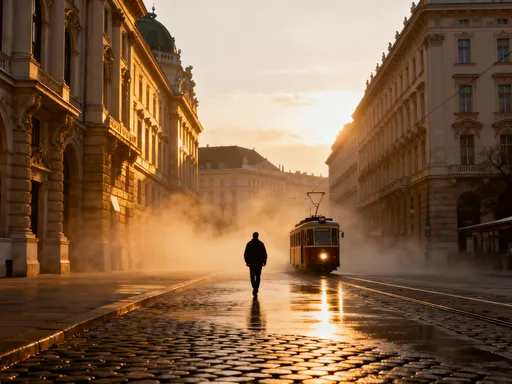
The Ringstraße also reflects the social stratification of its time. The inner side of the boulevard was reserved for public institutions, while the outer side became home to grand residential palaces for the aristocracy and wealthy bourgeoisie. This duality—public versus private, civic versus personal—adds depth to the street’s narrative. Today, walking the Ringstraße offers a panoramic view of 19th-century Vienna’s aspirations. Horse-drawn carriages still pass by, juxtaposed with modern trams, creating a layered experience of time. The boulevard remains a living space, used for festivals, markets, and daily commutes, proving that grand urban design can endure and adapt across generations.
The Birth of Modernism: Otto Wagner and the Wiener Werkstätte
By the turn of the 20th century, Vienna stood at a crossroads. While the Ringstraße celebrated historical revival, a new generation of architects sought to break free from the past. Leading this movement was Otto Wagner, a visionary who believed that architecture should reflect the needs and spirit of the modern age. His famous dictum—“Art belongs to its time”—became a guiding principle for a new aesthetic. Wagner’s work combined functionality with elegance, embracing new materials like steel, glass, and aluminum while maintaining a strong sense of design integrity.
One of his most iconic works is the Majolica House on Linke Wienzeile, named for its shimmering, glazed ceramic tiles in floral patterns. At first glance, it appears ornamental, but the design serves practical purposes: the tiles are durable, weather-resistant, and easy to clean. The building’s façade is both beautiful and efficient, embodying Wagner’s belief that form should follow function without sacrificing beauty. Similarly, the Postal Savings Bank on Ringstraße revolutionized public architecture with its minimalist façade, large glass panels, and exposed aluminum rivets. Inside, the open-plan hall with a glass ceiling flooded the space with natural light, creating a transparent and welcoming environment for citizens—a radical departure from the heavy, fortress-like banks of the past.
Wagner’s influence extended beyond individual buildings; he trained a generation of architects, including Josef Hoffmann and Joseph Maria Olbrich, who would go on to shape the Wiener Werkstätte (Vienna Workshop). Founded in 1903, this design collective sought to elevate everyday objects and spaces through craftsmanship and aesthetic unity. They believed that art should not be confined to museums but integrated into daily life—from furniture and tableware to entire interiors. The Stoclet House, though located in Brussels, remains a masterpiece of their philosophy, with its geometric façade, custom-designed interiors, and collaboration with artists like Gustav Klimt.
The Wiener Werkstätte emphasized clean lines, geometric forms, and high-quality materials, laying the foundation for modernist design. Yet, unlike later industrial modernism, they rejected cold impersonality. Every detail was handcrafted or carefully supervised, ensuring that beauty and humanity remained at the center of design. This balance between innovation and tradition continues to influence Viennese architecture today, reminding us that progress does not require the erasure of the past, but its thoughtful reinterpretation.
Art Nouveau with a Viennese Twist: The Secession Movement
No structure captures the spirit of artistic rebellion in fin-de-siècle Vienna more than the Secession Building. Designed by Joseph Maria Olbrich in 1898, it was conceived as a manifesto for a new artistic era. Its gleaming golden dome, composed of interlocking laurel leaves, resembles a metallic thistle rising above the cityscape. The inscription above the entrance—"To every age its art, to every art its freedom"—declares the movement’s core belief: that creativity should not be bound by tradition or institutional control. The Secessionists, a group of artists who broke away from the conservative Künstlerhaus, sought to create a total work of art that unified painting, sculpture, and architecture.
Inside, the exhibition hall is a minimalist space designed to showcase contemporary art without distraction. Its most famous feature is the Beethoven Frieze, a monumental work by Gustav Klimt created for a 1902 exhibition dedicated to the composer. Rendered in gold, black, and muted tones, the frieze depicts humanity’s quest for joy and redemption through art. The integration of architecture and artwork exemplifies the Gesamtkunstwerk ideal—a complete artistic environment where every element is harmonized. Though the Secession Building is small, its impact has been immense, inspiring generations of artists and architects to prioritize individual expression and innovation.
Beyond this iconic structure, the Secessionist influence can be seen in numerous residential buildings throughout Vienna’s outer districts. In neighborhoods like Währing and Döbling, villas and apartment blocks feature flowing lines, organic motifs, and stylized floral patterns rendered in stucco and metalwork. Facades are often painted in soft pastels, with windows arranged asymmetrically to create visual rhythm. These homes, though less famous than their public counterparts, represent the democratization of Art Nouveau—bringing avant-garde design into everyday life.
What distinguishes Viennese Jugendstil (the local term for Art Nouveau) from its counterparts in Paris or Brussels is its intellectual rigor and restraint. While French Art Nouveau embraced sinuous, almost erotic forms, the Viennese version favored geometric abstraction and symbolic content. This reflects the city’s strong tradition of philosophical and musical thought—art was not merely decorative, but a means of exploring deeper truths. Walking through these neighborhoods today, one senses a quiet sophistication, a city that values beauty not as ornament, but as a form of intelligence.
Contrasts in Concrete: Postwar and Contemporary Additions
The aftermath of World War II brought new challenges and opportunities for Vienna’s architectural landscape. The war had left parts of the city in ruins, necessitating rapid reconstruction. In the 1950s and 60s, functionalist housing blocks—known as Gemeindebauten—were erected to address housing shortages. These large-scale residential complexes prioritized efficiency and affordability, often using prefabricated concrete panels. While criticized for their uniformity, many of these buildings have aged gracefully, integrated into the urban fabric with well-maintained courtyards, green spaces, and community facilities. They reflect a social commitment to housing as a public good, a principle that remains central to Viennese urban policy.
By the late 20th century, a reaction against rigid modernism emerged in the form of postmodern and expressive architecture. The most famous example is Hundertwasserhaus, designed by artist Friedensreich Hundertwasser and completed in 1985. Rejecting the straight line as “the creation of man, not God,” the building features undulating floors, irregularly shaped windows, and a roof covered in soil and vegetation. Colorful tiles, tree tenants growing through windows, and golden onion domes give it a fairy-tale quality. More than just a residence, it is a philosophical statement—a protest against standardization and a celebration of individuality and nature.
In recent decades, Vienna has embraced contemporary architecture with confidence. The DC Towers, designed by Dominique Perrault and completed in 2014, stand as the tallest buildings in Austria. Their sleek glass façades reflect the sky and surrounding cityscape, creating a dynamic visual effect. Yet, their placement and scale were carefully considered to avoid overshadowing historic areas. The complex includes office spaces, a hotel, and public plazas, contributing to the city’s economic vitality while maintaining urban harmony. Similarly, the Central Library and the new campus of the Vienna University of Economics demonstrate how modern design can be both innovative and context-sensitive.
What sets Vienna apart is its ability to integrate bold new forms without disrupting the city’s overall character. New buildings are subject to strict design guidelines and public consultation, ensuring they contribute positively to the streetscape. This balance between preservation and progress reflects a deep civic consensus: that a city should evolve, but with respect for its heritage and its people. For visitors, this means encountering a city that feels both timeless and alive—a place where history is not a museum exhibit, but a living conversation.
Walking the Talk: How to Experience Vienna’s Architecture Like a Local
To truly appreciate Vienna’s architectural richness, one must slow down and explore on foot. The city is ideally suited for walking, with well-preserved sidewalks, clear signage, and a compact layout that allows multiple styles to be experienced within a short distance. Begin in the Innere Stadt, where a morning stroll from Stephansplatz to the Hofburg reveals centuries of architectural layers. Continue along the Ringstraße, pausing at key landmarks to appreciate their scale and symbolism. Audio guides and self-guided walking apps offer insightful commentary without the constraints of a fixed schedule.
For a deeper dive, consider themed walking tours—such as “Baroque Vienna,” “Jugendstil Discoveries,” or “Modernist Interventions.” These are often led by architects or historians who provide context and lesser-known anecdotes. Alternatively, rent a bike or take a hop-on-hop-off bus to cover greater distances while still enjoying panoramic views. The tram system, especially Line 1 and Line 2, runs along the Ringstraße and offers a comfortable way to observe the city’s architectural progression.
Combine your architectural journey with Vienna’s famed coffeehouse culture. After visiting Karlskirche, pause at Café Diglas or Café Sperl to rest and reflect. Order a Melange and a slice of Sachertorte, and watch the world go by from a window seat. Near the MuseumsQuartier, Café am Heumarkt offers a modern twist on the traditional café experience, with a spacious courtyard ideal for summer afternoons. These pauses are not distractions—they are essential to the rhythm of discovery, allowing time for observation and connection.
Visit early in the morning or late in the afternoon to avoid crowds and capture the best light. Golden hour illuminates façades in warm tones, enhancing textures and colors. Weekdays are generally quieter than weekends, especially during school terms. If possible, time your visit with Long Night of Museums or the Vienna Architecture Festival, when normally closed buildings open their doors and special exhibitions illuminate the city’s creative spirit. Most importantly, allow yourself to wander without a strict itinerary. Some of Vienna’s most beautiful architectural details—hidden courtyards, painted stairwells, sculpted door handles—are found by chance, rewarding curiosity and patience.
Conclusion: Where Past and Future Coexist in Stone
Vienna’s architecture is not a collection of isolated monuments, but a continuous dialogue between epochs. Each style—Gothic, Baroque, Ringstraße revivalism, Secessionist innovation, modernist clarity—adds a voice to the city’s ongoing conversation. What makes Vienna extraordinary is not just the beauty of its buildings, but the intention behind them. They were built not merely to impress, but to express values: faith, power, knowledge, freedom, and community. This depth of meaning transforms a simple walk into a profound experience, one that resonates especially with those who appreciate tradition, craftsmanship, and thoughtful living.
For the discerning traveler—often a woman in her thirties to fifties who values culture, history, and authenticity—Vienna offers more than visual splendor. It offers a sense of continuity, a city that has grown with care and purpose. There is comfort in knowing that progress need not erase the past, that innovation can coexist with reverence. In an age of rapid change, Vienna stands as a model of balance, showing how a society can honor its roots while embracing the future.
As you stroll through its streets, you are not just observing architecture—you are participating in a legacy. Each step connects you to centuries of human aspiration, to artisans and visionaries who believed that how we build reflects who we are. In Vienna, the past is not behind us; it is beneath our feet, around us, and within us. And as new buildings rise with respect and intention, the conversation continues—inviting each of us to listen, to admire, and to carry forward the enduring value of beauty in everyday life.